
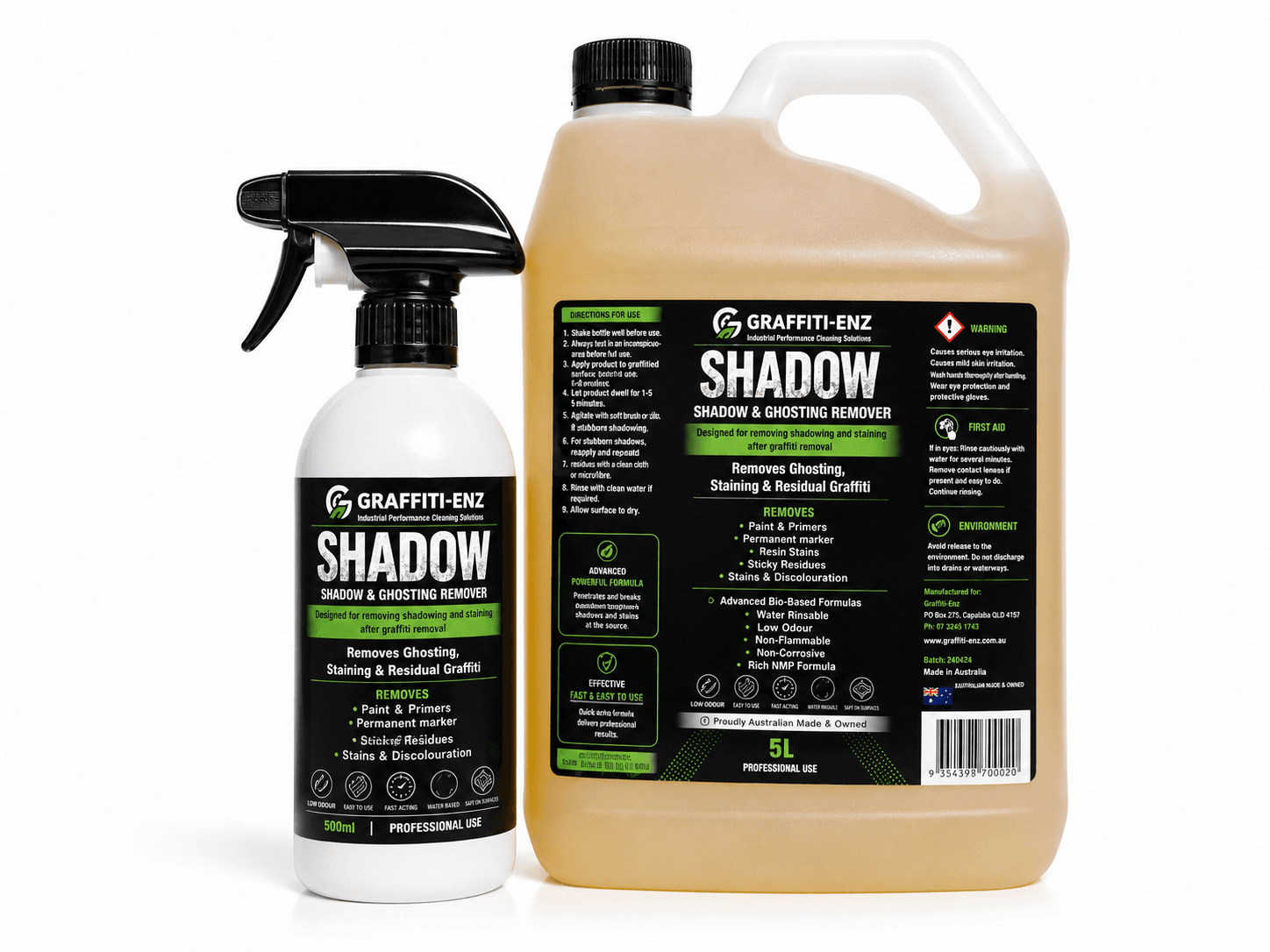
Graffiti-Enz Shadow Remover
Finishing product designed to reduce residual staining (“ghosting”) after primary graffiti removal.
Used as the final step when a surface still shows shadowing once the paint/ink has been removed.
Reduces ghosting
Asset presentation
Procurement ready
When to use Shadow Remover
- After the graffiti is removed but a visible “shadow” remains
- Porous or problem substrates prone to staining
- High-visibility assets where presentation matters
- When you want to reduce repeat visits caused by residual marking
and reduce “almost clean” results that trigger follow-up work.
When to use a primary remover instead
- If the graffiti itself hasn’t lifted yet, start with Graffiti-Enz Gold or Graffiti-Enz Red
- For quick, small incidents, consider Super Wipes
- Shadow Remover is not a first-step remover — it’s used after primary removal
What is “ghosting” (shadowing)?
Ghosting is residual staining or discolouration that remains once the graffiti paint/ink is removed.
It’s most common on porous surfaces, older coatings, and high-exposure assets where pigment can migrate into the substrate.
Shadow Remover is designed to help reduce that residual mark as a finishing step.
Surface compatibility (guide)
Shadow Remover is intended for use as a finishing product across common public-asset substrates
where residual staining is visible after primary removal. Suitability depends on coating type and surface condition.
- Painted and sealed masonry and concrete
- Durable infrastructure coatings
- Painted metal assets (spot test recommended)
- Public infrastructure and signage surfaces
Ghosting can be influenced by substrate porosity, paint age, UV exposure and previous cleaning history.
Safety, WHS and controlled use
Shadow Remover is designed for controlled operational use as part of a standard method.
Use in accordance with the SDS and site risk controls.
- Use as a finishing step after primary removal
- Apply with controlled technique to reduce overworking the surface
- Follow SDS guidance for PPE, handling and ventilation requirements
Documentation and compliance
- SDS available for download (PDF)
- Supports WHS review and supplier onboarding
- Additional procurement documents available on request
Safety Data Sheets are prepared in accordance with GHS requirements and
Australian WHS expectations, and maintained using Chemwatch.
Latest versions are available on request.
Typical finishing workflow (high level)
- Remove graffiti using a primary remover (Gold or Red)
- Assess the surface for residual staining/ghosting
- Spot test Shadow Remover in an inconspicuous area
- Apply Shadow Remover as a finishing step, then reassess outcome
If the graffiti itself is still present, return to a primary remover:
Gold for demanding sites or
Red for occupied/public-facing environments.
How Shadow Remover fits into the Graffiti-Enz system
Shadow Remover is typically the final step used to improve presentation and reduce rework
after primary removal has lifted the graffiti.
- Gold: primary remover for harder graffiti and demanding sites
- Red: routine removal in occupied/public-facing environments
- Shadow Remover: finishing step for residual staining/ghosting
- Super Wipes: rapid response for small incidents
We can recommend a standard product set and simple workflow to reduce misapplication,
repeat visits and inconsistent outcomes.
Need advice on ghosting for your assets?
Tell us your surface type and environment and we’ll recommend the safest finishing approach,
plus the right primary remover if needed.